

In recent years, 9D VR technology has emerged as a revolutionary force in the entertainment industry, offering an immersive and interactive experience that transcends traditional forms of media. As a leading 9D VR supplier, I am excited to share with you how this cutting - edge technology works and why it has become such a popular choice for entertainment venues around the world.
The Basics of 9D VR
At its core, 9D VR combines virtual reality (VR), augmented reality (AR), and motion simulation to create a multi - sensory experience. The "9D" refers to the nine degrees of freedom that the system can provide, including movement in three dimensions (X, Y, and Z axes), rotation around these axes, and additional sensory elements such as wind, water, and smell.

Virtual Reality (VR)
VR is the foundation of 9D VR technology. It uses a head - mounted display (HMD) to create a fully immersive virtual environment. The HMD typically has a high - resolution display and a wide field of view, which allows users to feel as if they are actually inside the virtual world. The display is refreshed at a high rate to reduce motion sickness and provide a smooth visual experience.
Augmented Reality (AR)
AR is used in 9D VR to enhance the virtual experience by overlaying digital information onto the real world. This can include adding virtual objects, characters, or effects to the user's view. For example, in a 9D VR game, AR could be used to project a virtual enemy onto the real - world environment, making the game more interactive and engaging.
Motion Simulation
Motion simulation is a crucial part of 9D VR. It uses a specialized platform or chair that can move in multiple directions, replicating the movements and sensations of the virtual environment. The platform can tilt, rotate, and vibrate to create a realistic sense of motion. For example, if the user is in a virtual roller - coaster ride, the platform will move in sync with the movements of the roller - coaster, providing a thrilling and immersive experience.
How 9D VR Equipment Works
The Egg Chair
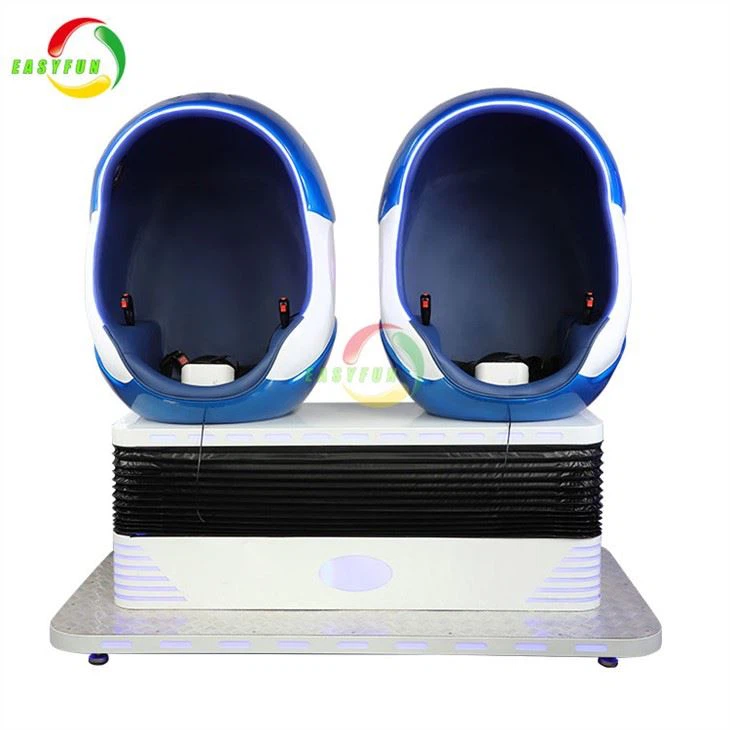
One of the most popular 9D VR setups is the Hot Selling 9D VR Cinema Simulator Virtual Reality Egg Chair. This unique chair is designed to provide a comfortable and immersive experience for users. The egg - shaped design allows for a snug fit, and the chair can be adjusted to accommodate different body sizes.
The chair is equipped with a high - tech motion system that can move in all nine degrees of freedom. The motion system is controlled by a computer that receives data from the VR content. When the user moves in the virtual world, the chair moves accordingly, creating a seamless and realistic experience.
The Head - Mounted Display
The HMD is the primary interface between the user and the virtual world. It typically has two high - resolution displays, one for each eye, which creates a stereoscopic 3D effect. The HMD also has built - in sensors that track the user's head movements. These sensors send data to the computer, which then adjusts the virtual environment accordingly. For example, if the user turns their head to the left, the view in the virtual world will also shift to the left.
The Control System
The control system is the brain of the 9D VR setup. It consists of a computer that runs the VR software and controls the motion system and the HMD. The software is responsible for rendering the virtual environment, processing the sensor data, and synchronizing the movements of the chair and the HMD.
The control system also allows for the integration of additional sensory elements. For example, it can control fans to create a wind effect, water sprayers to simulate rain, and scent emitters to add a realistic smell to the virtual environment.
The Content for 9D VR
The success of 9D VR depends not only on the technology but also on the quality of the content. There is a wide range of content available for 9D VR, including action - packed games, thrilling rides, and educational experiences.
Action Games
Action games are a popular choice for 9D VR. They typically involve battling enemies, solving puzzles, or completing missions in a virtual environment. The motion simulation and multi - sensory effects make these games more immersive and exciting. For example, in a shooting game, the user can feel the recoil of the gun through the chair's vibrations and hear the gunshot sounds clearly through the HMD's audio system.
Thrilling Rides
Thrilling rides, such as roller - coasters and space flights, are another popular type of 9D VR content. The motion system of the chair can accurately replicate the movements of these rides, providing a realistic and exciting experience. The addition of wind, water, and other sensory effects further enhances the immersion.
Educational Experiences
9D VR also has great potential in the field of education. It can be used to create virtual field trips, historical reconstructions, and scientific simulations. For example, students can explore the solar system, visit ancient civilizations, or conduct virtual experiments in a 9D VR environment.
Advantages of 9D VR
Immersive Experience
The most significant advantage of 9D VR is its ability to provide an immersive experience. Users can feel as if they are actually in the virtual world, which is much more engaging than traditional forms of entertainment. The combination of visual, auditory, and tactile sensations creates a truly unforgettable experience.
Multi - Sensory Stimulation
9D VR offers multi - sensory stimulation, which is not possible with traditional media. The addition of wind, water, and smell enhances the realism of the virtual environment and makes the experience more memorable.
Customizable
9D VR systems are highly customizable. They can be tailored to meet the specific needs of different customers. For example, an arcade can choose different types of content based on the preferences of its customers, and the motion system can be adjusted to provide different levels of intensity.
Applications of 9D VR
Entertainment Venues
9D VR is widely used in entertainment venues such as arcades, theme parks, and cinemas. It provides a unique and exciting experience that attracts customers of all ages. The Hot Selling 9D VR Cinema Simulator Virtual Reality Egg Chair is a popular choice for these venues due to its compact design and high - quality experience.
Training and Education
As mentioned earlier, 9D VR has great potential in the field of training and education. It can be used to train pilots, surgeons, and other professionals in a safe and controlled environment. In education, it can make learning more engaging and effective by providing students with hands - on experiences.
Marketing and Advertising
9D VR can also be used for marketing and advertising purposes. Companies can create virtual experiences to showcase their products or services. For example, a car manufacturer can create a virtual test drive experience, allowing customers to experience the car's features in a realistic way.
Why Choose Our 9D VR Products
As a 9D VR supplier, we are committed to providing high - quality products and services. Our 9D VR systems are designed with the latest technology and are built to last. We offer a wide range of content options to meet the diverse needs of our customers.
Our team of experts is always available to provide technical support and assistance. Whether you are setting up a new arcade or upgrading an existing one, we can help you choose the right 9D VR system for your business.
If you are interested in purchasing our 9D VR products or learning more about our services, please feel free to contact us. We look forward to discussing your requirements and helping you create an unforgettable 9D VR experience.
References
- "Virtual Reality: A New Medium with New Expressive Potential" by Jaron Lanier
- "Augmented Reality: Principles and Practice" by Steve Feiner, Daniel Azuma, and Richard MacIntyre
- "Motion Simulation Technology: Principles and Applications" by John R. Jex